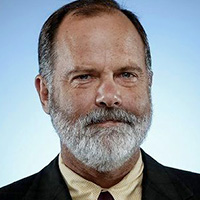






















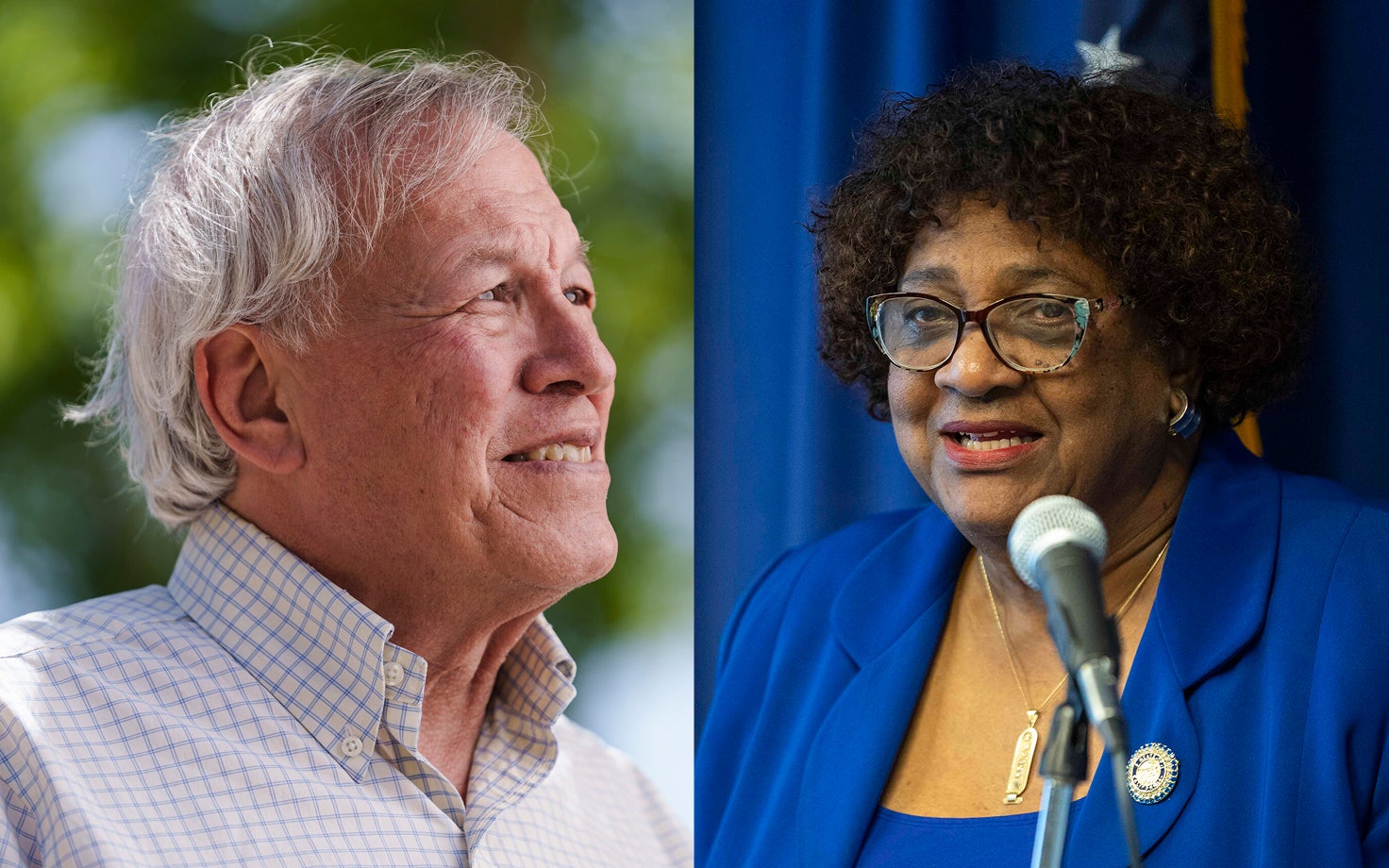
Democracy has few better friends than Erwin Chemerinsky, dean of the law school at UC Berkeley and prolific writer on American law and politics. Cheerful even when discussing the gravest threats to democracy and American institutions, Chemerinsky has for decades devoted his powerful intellect to the understanding of the legal system, sketching a broad vision of its responsibilities — and shortcomings. Nor has his work been confined to the academy. His books are popular with lawyers and law professors but also with lay people, and he is frequently sought out by journalists and others attempting to understand rulings of the Supreme Court. His 2024 book, “No Democracy Lasts Forever,” is an extended look at failures in American democracy.
In the late 1990s, Chemerinsky chaired the Elected Los Angeles Charter Reform Commission, which exhaustively reviewed the city charter and proposed a sweeping set of reforms that touched on almost every aspect of city governance and representation. The commission joined forces with an appointed counterpart and the package they submitted to voters was overwhelmingly approved in June 1999.
Interviewed by Blueprint editor-in-chief Jim Newton in his Berkeley office, Chemerinsky discussed the myriad threats to American democracy. It was, in a sense, just the most recent chapter in a conversation about governance and democracy that the two have been having for nearly 30 years.
Blueprint: When you talk about democracy and some of the challenges this democracy is facing, you mean more than just voting. You’re talking about the rule of law, due process, protection of minorities, a lot of principles that we associate with American democracy but that are only indirectly related to voting. How should we think about “democracy” and its relation to those other ideas, and how is it faring today?
ERWIN CHEMERINSKY: What we mean by democracy, of course, is the government where those who hold office are elected by the people, and at regularly scheduled elections.
The Constitution, of course, creates a presidency, a Congress, and at the state level, the governor, the legislature. … That’s the most simplistic definition.
And then, of course, there’s a huge literature on what’s required for democracy to be effective. I think our democracy has been flawed from the beginning. … Look at the branches of the government that are created by the Constitution. The Electoral College is not chosen by the people. In fact, early in American history it was state legislatures that chose the electors… It was very much about protecting the political power of the states that had slaves. And that was recognized at the time. Delegates to the Constitutional Convention from North Carolina and from Virginia praised the Electoral College because it would give more political strength to slave states than they would otherwise have had.
And the reason, of course, is, by that point, the convention had already chosen the three-fifths clause [granting slave states representation based on their White population as well as counting
each slave as three-fifths of a person for census purposes]. And that’s why almost every president elected for the first decade of American history was from the South.
More recently, twice in this century, we’ve had someone chosen as president who lost the popular vote, and it almost happened two other times. It’s hard to see the Electoral College and the choice of president as democratic as we’d normally define it
BP: And then there’s the Senate, two senators per state regardless of the size of the state.
EC: The Senate is the only elected body in the United States that doesn’t have to follow the principle of one person, one vote. In the time of the Constitutional Convention, the difference between the most populous state and the least populous state was about 10 to 1. Now it’s more like 68 to 1 [California, the most populous state, has roughly 40 million residents while Wyoming, the least populous, has about 590,000. Both, of course, have two senators]. In the first two years of the Biden presidency, there were 50 Democratic senators and 50 Republican senators, but the 50 Democratic senators represented 42 million more people than the 50 Republican senators.
And then, of course, for good reason, the federal judiciary, the Supreme Court, federal judges are appointed by the president and confirmed by the Senate, so there’s no sense of those being democratic.
What that means is that only the House of Representatives was created to be representative. And the Supreme Court’s willingness to allow partisan gerrymandering undermines democracy in that body as well.
So in that sense, I think that the structure of the government is very flawed relative to democracy.
BP: And those flaws, at least in terms of democracy, were there from the beginning. But you also see it getting worse?
EC: There’s a whole political science literature that shows that because of population shifts, we are much more likely to have a candidate lose the popular vote and win in the Electoral College. It never happened in the 20th century, but it’s happened, obviously, in 2000 [when Al Gore won the popular vote but lost the Electoral College to George W. Bush], and in 2016 [when Hillary Clinton won the popular vote but Donald Trump prevailed in the Electoral College]. And it nearly happened in 2004: Had John Kerry won Ohio, it would have happened then, too.
BP: As you point out in your book, the way the American population is distributed at this point makes it very unlikely that a Democrat would lose the popular vote and win the Electoral College, so while these observations about the Electoral College are not partisan, they have partisan implications.
EC: That’s right.
BP: I was struck by something I had never thought of until I read it in your book, that there might be a nonconstitutional amendment route to the abolition of the Electoral College.
EC: So let me start by saying it’s not going to happen
BP: We can dream …
EC: Constitutional amendments modify the text of the Constitution. Here’s an easy example: Were it not for the First Amendment, Congress could use its commerce power to license newspapers. But the First Amendment means that the government can’t license newspapers, so the amendment modifies the text.
When it comes to the Electoral College, the Supreme Court has said, in interpreting equal protection [guaranteed by the 14th Amendment], that it creates a requirement of one person, one vote. Well, the Electoral College is inconsistent with one person, one vote. [The Court could, therefore, hold that the 14th Amendment made the Electoral College unconstitutional.]
BP: OK, so if we assume for a moment that this Court is unlikely to do that, how else could the Electoral College be changed in order to make it more democratic?
EC: Congress could pass a law eliminating winner- take-all [which in almost every state awards the popular vote winner all of that state’s electors]. Winner-take-all is not in the Constitution, as you know.
And yet, 48 states, all but Maine and Nebraska, use winner-take-all.
Congress can set the rules for federal elections, so Congress could say that no state can use winner-take-all and then you could, for instance, allocate its electors on the basis of congressional districts …
BP: There would still be inequality in that a California congressional district has many more people than Wyoming’s only district, but at least it would be closer than winner-take-all.
EC: I think the best that we could hope for would be for Congress to say, eliminate winner-take-all. And the same goes for partisan gerrymandering. This may be even more realistic. Congress could pass a law that says that every state in drawing congressional districts must use an independent commission, and that the commissions cannot engage in partisan gerrymandering. Congress can’t do that for state and local elections, but Congress could do it for House of Representatives elections.
BP: And one can imagine the politics of that lining up. It’s easy to be against gerrymandering, whether you’re a Republican or a Democrat.
EC: Exactly.
BP: Do you give any weight to the idea that candidates pay more attention to small states because of the Electoral College?
EC: I don’t know how much it matters. In our world of media, of course, candidates are always choosing where to pay attention.
And ultimately, I ask the question: So what? So what if the candidate doesn’t make an appearance in Wyoming? Why is that more important than having the winner of the popular vote win the election?
BP: Talk about the Senate, which, as you’ve already said, is this anomalous institution. And it’s not because of the bicameralism, the fact that we have two chambers of Congress, it’s the fact that we allocate a fixed number of senators per state. And it would be very difficult to fix — that is the one thing I can’t think of a fix for …
EC: … because Article Five of the Constitution says it’s one of the two provisions that can’t be changed by amendment. [The other was the original Constitution’s prohibition against interfering with the slave trade for 20 years after adoption of the Constitution, a provision that long ago became moot.]
BP: The only remedy for the Senate, then, is a constitutional convention. Am I right?
EC: But a constitutional convention can’t change that either. Oh, because remember, Article Five says that the two provisions that can’t be amended …
BP: Wouldn’t a new constitutional convention produce a new constitution?
EC: In theory. I mean, it could. The reason I’m hesitating is if you take seriously Article Five, what it says is, no matter how you go through the amendment process, this provision can’t be changed.
There’s two ways to amend the Constitution. One way is what all 27 amendments have done: Win approval from two-thirds of both houses of Congress and three-quarters of the states. But Article Five also has an alternative way of amending the Constitution: When two-thirds of the
states call for a constitutional convention, that convention meets and proposes something. Then if that’s approved by three-quarters of the states, it’s a constitutional amendment, but it’s still an amendment, and Article Five still says you can’t change the Senate.
So in theory, the only way to change it would be a new constitution.
BP: It would appear that we’re stuck with the Senate, at least for the foreseeable future, and with it, the obviously anti-democratic fact that it gives the voters of small states vastly more power than the voters in big states.
EC: And of course, all of it’s made worse by the filibuster, because it means that an ever-smaller percentage of senators representing an ever-smaller percentage of population can block things.
BP: But if reforming the Senate is the most difficult of the various measures that might make the United States more democratic, ending the filibuster is the easiest. It doesn’t take a new constitution or even a constitutional amendment or even a statute. It’s just a Senate rule.
EC: It’s just a majority vote. The Senate could do it tomorrow. But as much as Trump has pushed the Senate to eliminate the filibuster, the Republicans don’t want to do it because they know that they could be in the minority someday soon, and this is the protection.
BP: There’s a part of me that hesitates over all of this, that wonders about being careful what to wish for. We could certainly have a much less hindered democracy if we enacted the reforms you’re talking about here. But would we want that? Do we risk endangering the rights of minorities if we embrace democracy completely? Is there a logical limit to democracy in all of this?
EC: I want to answer your question by saying, initially, that I don’t think that the institutions that the Constitution creates achieve that. I don’t think the Electoral College does anything in terms of protecting the rights of the minority.
I’m skeptical that having small states overrep- resented in the Senate does anything to protect the rights of the minority in the sense that we’re talking about. Maybe it helps to protect small states as small states …
What we’ve come to over time is that we really want the courts to be the institution to protect minorities. That doesn’t mean they always, or even often, succeed in that. But I think what we’ve come to think of is the real check on the access is the majority process. … And that’s why I’m very skeptical of those on the left now who really want to attack judicial review. … And this has become very trendy among progressives, and I understand why. And yet … at this moment in time, with this president, our only guardrail has been the courts. They haven’t always held, but it does feel like they’ve been the last resort many times. If there’s going to be a protector for minorities in the way we talk about it, it is much more likely to come from the judiciary than from the political process.
BP: Earl Warren often said that he didn’t think that if the American people were presented with the Bill of Rights today, they would ap- prove them. Are you at all worried, if we could convene a new constitutional convention, that things like gun rights or abortion rights or privacy or free speech — things that many of us in various combinations hold quite dear — might suddenly be on the block?
EC: Yes. Let me start by saying that at some point there will be a new constitution. No constitution, no form of government, lasts forever. The question is the when and the what, and the when will probably be long beyond our lifetimes.
I’m not sure what will come of it. And it’s hard to project what the issues of the moment will be, but I never imagined we would see a threat to democracy from the president. We’ve never had a president with so little regard for the rule of law, for the norms of the office. And I don’t know what follows from that either, but at some point, there’s going to be a realization that we need a constitution for the world we live in today.
The more the Supreme Court says the Constitution means only what it meant in 1787, the more certain that we will need a new constitution. And there is a great danger that the constitutional convention could lead to something worse.
But it could also lead to something better. And I think whatever came from it would be a huge compromise.
BP: You’ve had some actual experience with this, as the president of the elected Los Angeles Charter Reform Commission. You didn’t write a new national constitution, but you wrote a city charter, and did so through a long, often difficult process.
EC: Charter reform is on a smaller scale. … But what we learned from the experience was that everything was going to be a compromise, and that we wanted our efforts to be fruitful. That the reason that George [Kieffer, president of the city’s appointed charter reform commission, which operated in parallel to the panel headed by Chemerinsky] and I came together to negotiate the Unified Charter was the recognition that unless we did that, all our efforts would fail.
And for a constitutional convention … the people involved would know that they’re going to be judged long into the future by how they performed in that role. The desire to have their efforts be fruitful, and their desire to be judged positively by history will, I think, cause people to be better than they otherwise might be.
BP: I’d credit you with real experience in that regard. That’s not an optimism just hatched in this office. That is an optimism born of the experience of actually working through a city charter, not a national constitution, but a foundational document.
EC: And everything was deeply contested. There were disagreements over everything. In the end, what we wanted to do is produce a document that was better than what existed. Obviously not what any of us would have done on our own. And that ultimately passed with 60% of the vote.
So my hope is that, in that sense, that experience of people compromising, people wanting their efforts to lead to something, because if it’s too extreme, it won’t be approved.
Imagine that one side or the other captures the constitutional convention. It produces a document that then has to go to the people.
Those who came to the original Constitutional Convention included some very brilliant men, but they performed better because of the sense of the importance of their role, and that’s my hope
BP: When it comes to the core of democracy, voting, we have an unusual problem at the moment, which is that doubts about the voting process emanate from the president himself. And that creates a terribly difficult problem for democracy if the president sows such doubts about the fundamental exercise of the franchise, even though it’s the same process that brought him to power. Has any prior president ever sown such doubts about democracy?
EC: There never has been a president who has done this. And even losing presidential candidates who could have done that, did not. Richard Nixon could have said that he was cheated, and he very well may have been cheated [in 1960]. Al Gore had a strong argument … but he said no.
Trump not only continuing to say that he won the 2020 election with no evidence to support it, but fostering such distrust in the electoral process, is unique.
I don’t know how you build trust. Let me go to a larger point, which I write about in the book but believe even more now. Our government, and for that matter, all of the major institutions of society, have really lost the faith of the people. Congress has its lowest approval rating ever. … The Supreme Court is at its lowest approval rating in history. The president is in the low to mid-30s, which is basically his core support. Universities are at their lowest approval. The media has its lowest approval.
And so one of the things that causes me really to fear for democracy is to wonder whether democracy can survive where none of the institutions, either of government or outside the government, have the faith of the people. And so when you ask about the confidence in the elections, I put it into a much larger loss of confidence.
BP: Meanwhile, though, work goes on, especially at the local level. L.A. city adopted the charter that you helped create. L.A. County is now in the business of revamping its structures — expanding the board of supervisors, creating a countywide elected leader. Do you hold out hope that those efforts can yield tangible benefits for people in places like Los Angeles city or county, even amidst all the rest of this?
EC: Yes. Take an easy example. States can provide protection of rights where it doesn’t exist under the Constitution or federal law. So states can provide protection of abortion rights, for instance. States don’t have to follow a federal mandate. Los Angeles has long had the police regulation that it won’t [stop people based solely on sus- picion about their immigration status]. Because otherwise witnesses or victims of crime won’t come forward? School systems can say we’re not going to do it because we don’t want kids to miss school. Public hospitals can do that. So that’s a way in which I think local governments can push back.
BP: And in terms of democracy?
EC: Well, the Board of Supervisors is expanding and creating the position of a countywide CEO or mayor. Those are really democratic changes. Having just five supervisors for a county the size of Los Angeles is a real problem in terms of democracy. … So I think those are pro-democratic changes.
I still believe the city council … should be a much larger, and [the city’s system of] neighbor- hood councils [created by the charter reforms that Chemerinsky helped lead] are contributing.
BP: They are clearly a place where people come together.
EC: To work on solutions. And they are a re- source. It’s democratic and allows for popular participation.
There is the opportunity for local governments to make a difference, and local governments can be even more democratic as neighborhood councils are expanding.
BP: That’s something to hold onto. Thank you.
EC: I still believe that history shows tremendous expansion of freedom and equality. And I still believe our country will get through this, but I’m worried about it.