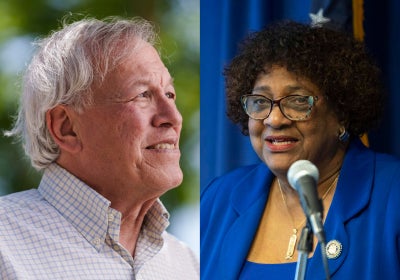











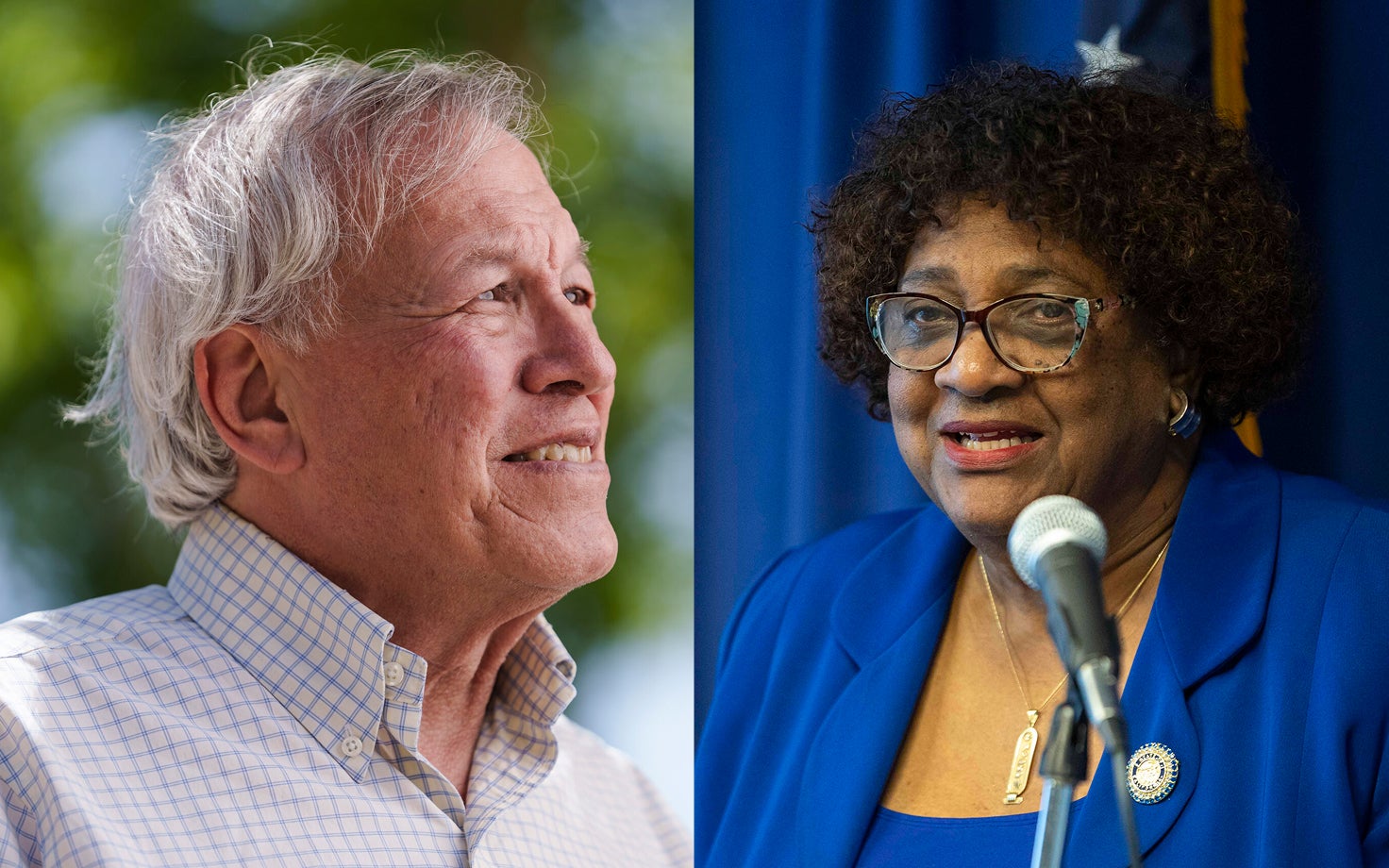
Shirley Weber is one of the most highly educated people in California government. She holds an undergraduate degree, a master’s degree and a Ph.D., all from UCLA. And she got them the hard way. Born in Hope, Arkansas, she is the daughter of a sharecropper who brought the family west after a lynch mob threatened his life. He counseled his daughter to shrug off insults such as he had borne, to be “better, not bitter.”
She has lived up to that charge. At the end of 2020, when Kamala Harris left the U.S. Senate to serve as vice president to Joe Biden, Gov. Gavin Newsom appointed then-Secretary of State Alex Padilla to fill Harris’ seat, and he named Weber, a veteran of the California Legislature, to take over as Secretary of State. She was confirmed in early 2021, was elected to the office in 2022 and has held it since.
Plainspoken, charming and incisive, Weber now oversees the election machinery of California. She spent much of the summer fending off false charges from President Donald Trump and his supporters that the system here was “rigged” — and curiously so, in that those doing the rigging somehow managed to throw the Los Angeles mayoral runoff to a democratic socialist while still allowing a Republican, Steve Hilton, to make the gubernatorial runoff against Xavier Becerra. Weber stood by the results, though she acknowledged that Trump’s blast furnace of false allegations has taken a toll. She’s preparing for another round of deception and distraction as the midterms approach.
Dr. Weber met via Zoom with Blueprint editor-in-chief Jim Newton earlier this fall, in the lull between elections.
BLUEPRINT: Are elections in California safe? Can voters of this state be confident that their votes are being counted accurately, and that voting is limited to those who are entitled to vote?
SHIRLEY WEBER: You know, we’ve been asked that so much. Not only us, but also all of the re- search institutes and the various folks who deal with elections up and down the state and various universities have all looked at this and said, for all intents and purposes: The elections in California and across the nation are safe elections. …
One of our researchers went back 35 years and only found four or five people who had actually committed any level of fraud in terms of elections. The administration talks about it, creates a frenzy about it. … And so it becomes very frustrating not only to us but also to the public. …
You hope at some point that Californians kind of wake up and see what’s going on.
When you don’t have the person at the top of the ticket, the president of the United States, defending its own institution and its own process, it creates an unbelievable sense of distrust.
BP: President Trump lost to Hillary Clinton here in 2016 by 4 million votes, and he blamed that loss on illegal voting by undocumented immigrants, or, in his words, “illegal aliens.” So let me ask you directly: Has there ever been any shred of evidence of illegal votes in that election that cost Trump a victory here?
SW: No. There hasn’t been that information anywhere. And if it were, they would present it, I mean, they would present that evidence to us.
To say, “I would have won California if it weren’t for all those undocumented [what he calls] illegal aliens and those kinds of things, 4 million votes,” … is really disheartening.
I think people are losing interest in listening to the president with regard to the information he presents. When we first got into this office, most folks in the press were kind of hesitant about saying the man is not telling the truth. They would say, “Well, it’s distorted information.” Now, you guys just boldly say, “We all know he’s not telling the truth, but this is what he said today.”
It’s unfortunate, but it’s also very sad that we have to be confronted with this, and that some people still have a tendency to think there might be some truth to it.
BP: The president also has alleged that Spencer Pratt was improperly denied a spot in the runoff in the L.A. mayor’s race — although he doesn’t seem to have complained about the results that put Steve Hilton in the runoff in the governor’s race on the same ballot. So may I just again ask you directly: Has any evidence come to your attention of any fraud in the L.A. election that would have caused Pratt to fall short?
SW: Not at all. … Anybody who knows about elections knows that you go into an election night with some votes still out there and coming in later. Folks who vote by mail have greater resources and so forth and so on. And they’re going to vote early. … And anybody who’s dealt with elections for any length of time knows how things worked in different communities, poor neighborhoods.
To say that, you know, all of a sudden, this guy Pratt was denied … well, it’s convenient.
BP: I’ve been writing about Los Angeles elections now for more than 30 years, and I must say that the notion that there’s something suspicious about an election in which a very liberal city chooses two fairly liberal candidates to run against each other in a runoff seems like a stretch.
SW: I don’t know how they expected it to end up.
BP: The president avails himself of mail-in voting, but he also suggests that there’s something inherently fraudulent about it. In fact, he called it “mail-in cheating” recently. Is there any reason to think that mail-in voting is more susceptible to fraud than any other kind of voting?
SW: Not that we’ve seen, especially if you understand the way that we count the ballots that come in [through mail-in processes]. If we just said, “OK, throw your ballot in the box,” that’s one thing. But the fact is that we have created this system where there are safeguards. There are envelopes that have certain codes and match your name. You have to verify the signature on it.
Now, of course, we get criticized for that because of the fact we want to verify every signature. We want to make sure that that ballot is your ballot and not somebody across the street, that people aren’t just picking up envelopes as they go through the neighborhood.
We do it to verify the signatures, to make sure that that ballot that’s being counted is actually your ballot and your signature is valid. We make sure that before we even put it in a position to be counted, it’s actually certified.
People didn’t think it was a bad system when those who had resources used it. Then it was the best thing since sliced bread. And poor people didn’t trust it. They didn’t think the system really worked for them.
I don’t know if the president ever walked into a polling place to vote.
BP: I’ve never seen him do it.
SW: He could have had them put in a polling place in front of the White House, and he could have walked in, but he chose not to because he believed in the system himself.
BP: It strikes me that you’re really caught between a rock and a hard place. If you take the time to do the verification that you’re describing, people complain that the slow count is evidence of fraud. But if you don’t take the time to do it, they complain that you’re not being careful with the ballots, and that’s evidence of fraud. There’s just no winning that argument.
SW: There’s no winning it.
BP: I wonder whether you see it as your goal as Secretary of State to make the vote as available to as many people as possible. What do you think of that as an objective, and also, is that at all at odds with election security? In other words, the things that you do to make it easy to vote, do those same things make elections more vulnerable?
SW: You know, I think all of us have this idea, this vision, that every Californian, every American should have as a part of their DNA the desire to vote, that who they are is determined by voting. People should have an interest in voting. …
I know it in my life because my parents never got a chance to vote in Arkansas. When my parents came to California, this was it. And they voted in every election there was, and they demanded that we do also.
So it’s hard to even imagine people not wanting to vote, because I’ve seen people around the world who could not vote. … We have a tendency to go in and out of our thinking with regards to voting. That’s unfortunate because we have taken it so for granted
We just assume good things will happen, you know, on its own without us having anything to say about it. And I was reading some articles recently, of course, what is happening now with the Voting Rights Act and so forth, and so on.
And I hate the fact that I’m constantly beating up on folks, dragging young people out, making them come vote. I’m hoping that they will see what they need to see, without me having to tell them. That’s the fear: that we have become so convenient and so liberal in our thinking that we don’t really see the sense of urgency. It is quite a challenge.
What’s happening now is exactly what can happen when you don’t take the vote seriously and you don’t participate on a regular basis, because it is your responsibility to do so.
BP: It must be really hard to say to people, “Your vote matters,” when the president of the United States is out there saying, “Your vote won’t count.”
SW: That’s the weird thing. You’re the president. You have resources available to you that when you retire, leave this place, you’ll be set for life. You have unlimited opportunity … and yet you’re the person who’s saying, “This is crap. Don’t trust the system that elected me.” …
To me, it’s heartbreaking. I’ve spent so much time writing legislation, fighting battles, trying to create opportunities for people, knowing how important education is with my life and everybody else’s life, and trying to make sure that everybody gets something that makes a difference and that changes the narrative for them and moves them forward. And then they have this person who just dumps it. …
I wake up wondering, what world do I live in? Is it real, or what’s happening? But we’ve got big things and issues. And I’m hoping and praying that people see that.