
























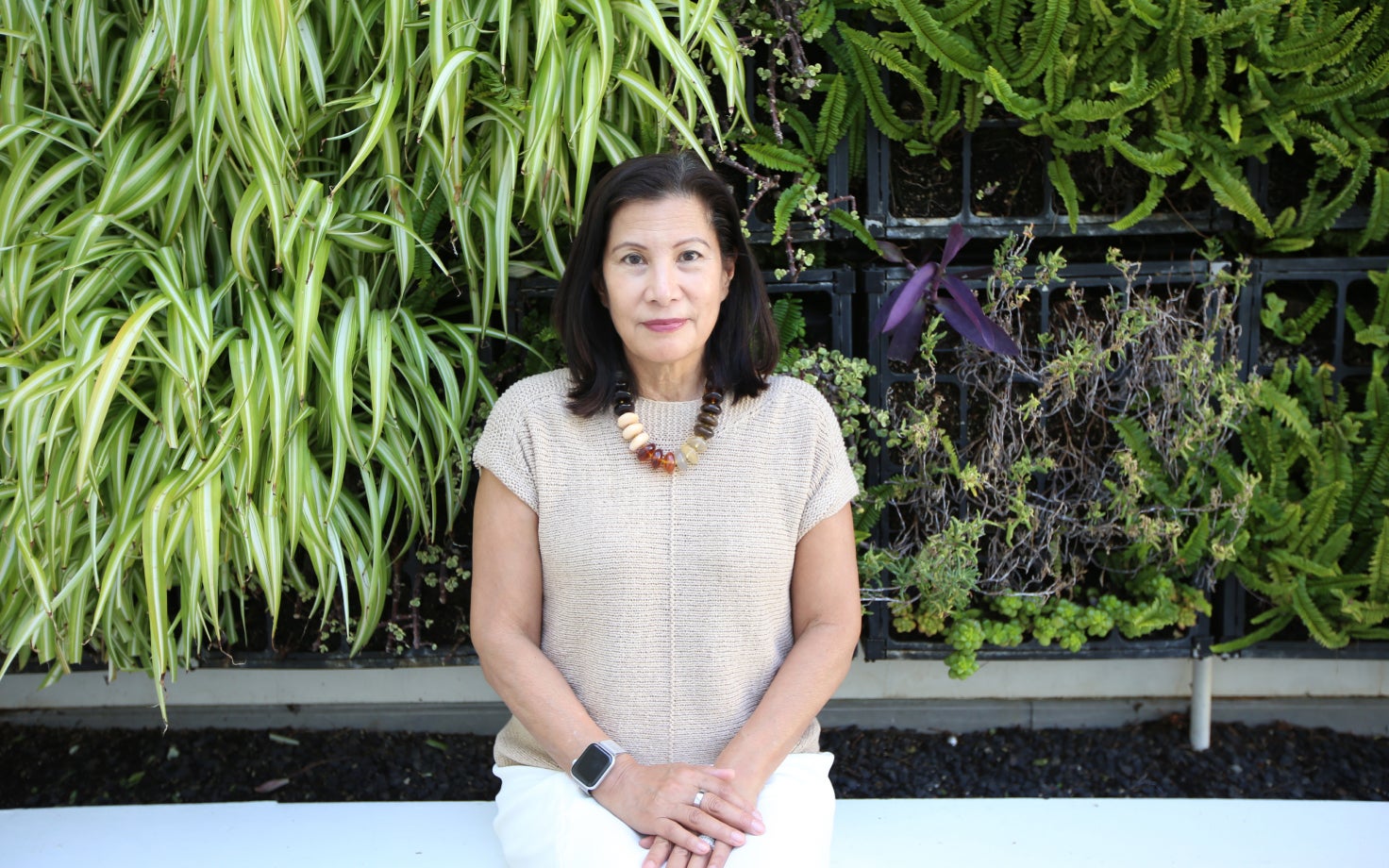
Tani Cantil-Sakauye was a California judge for 32 years, donning the black robes of impartiality and rising to become the state’s chief justice, leading the nation’s largest state system of trial and appellate courts.
When she stepped down as chief in 2023, she could have retired to spend more time playing tennis, a passion since college, or with her two dogs, a standard poodle and a “blind, incontinent rescue who teaches me patience and kindness.”
Instead, she became president and CEO of the Public Policy Institute of California, whose mission is to conduct nonpartisan, data-focused policy research on state issues.
The move “gave me a different route” to influence policy, she said.
PPIC also allows Cantil-Sakauye to pursue a long-standing commitment to civics education that took root when her family lost its home to eminent domain, the house where she grew up destroyed to make room for a mixed-use, commercial and residential area that would support the city’s tax base.
That experience taught her that “government affects your life — whether you pay attention or not.”
Now, as the second Trump administration uses its authority to punish California and other Democratic-leaning states, denying researchers access to grants and even withholding money to help homeowners recover from fires, Cantil-Sakauye worries that federal actions threaten state institutions and the constitutional rights of Californians. She and her PPIC colleagues, collaborating with researchers at other organizations, are working to mitigate the impact of these federal attacks on the state and its residents.
A formative moment
A Sacramento Native, Cantil-Sakauye grew up in an extended Filipino American family that lived in a cluster of residences in a poor neighborhood slated for redevelopment. She was eight years old when the city filed eminent domain proceedings to take her family’s home. Too poor to hire an attorney, her immigrant mother, who had only a high school education, represented the family in court — and lost. “I had never seen my mother so dejected, so upset, and I gleaned it was from how she was treated as a pro per in front of a judge in Sacramento,” she said. Forfeiting the properties caused a lasting rift in the family. Passions divided relatives, who became estranged. The government action left a lasting sadness over the family, and left young Cantil-Sakauye determined to understand it better.
“I needed to understand how government works, what the levers of power are,” she recalled.
Now in her 60s, Cantil-Sakauye spoke on Zoom from the Sacramento home she shares with her husband, Mark Sakauye, a retired police lieutenant. Despite a low-grade fever that had kept her from PPIC’s San Francisco headquarters for a few days, she talked easily, occasionally pausing after answering a question to ask her interviewer, “What do you think?”
The couple have two adult daughters. Cantil-Sakauye earned her undergraduate and law degrees at UC Davis, working briefly as a blackjack dealer at Harrah’s Tahoe to help with law school expenses.
A stint with the Sacramento prosecutor’s office, where she worked as a deputy district attorney, followed. In 1990, Gov. George Deukmejian appointed her to the Sacramento Municipal Court. Governors Pete Wilson and Arnold Schwarzenegger elevated her to the Superior Court and the Court of Appeal, respectively.
Elevated again by Gov. Schwarzenegger, Cantil-Sakauye became California’s second woman chief justice (Rose Bird, appointed by Gov. Jerry Brown in 1977 and removed from office in 1986, was the first) and the first person of color. The state’s courts then faced the single largest budget cut in its history — over $1 billion — part of the long tail of the 2008 recession.
To address the shortfall, Cantil-Sakauye surveyed the state’s more than 1,800 judges, asking for ideas on how the courts could operate more efficiently. Many of those suggestions were later adopted by the California Judicial Council, the courts’ policy-making arm, along with a formula to make trial court funding more equitable across the state.
She also pushed for reforms that might have made a difference to litigants like her mother.
Expanding democracy’s reach
To encourage Californians to learn about and participate in their government, Cantil-Sakauye worked with educational leaders and the legal community, launching the Power of Democracy campaign, a blueprint for revitalizing civics education and promoting civil discourse. She invited students to mock court sessions, “swearing in” robed elementary school “ judges,” and improved language access for those with limited English.
“It was remarkable how engaged the chief justice was in actively addressing the glaring void in civics education for young people,” said Raphael Sonenshein, now executive director of the Haynes Foundation, who headed the Pat Brown Institute for Public Affairs at Cal State L.A. when the institute honored Cantil-Sakauye for that work in 2015.
Sonenshein saw Cantil-Sakauye’s move to PPIC as a logical step. “At the Supreme Court, you’re mostly dealing with things that are brought to you,” he said. “It’s not a shock that in her post-court career, she would find a place where she could take the initiative in areas she considered to be of critical statewide importance.”
PPIC’s policy research spans a broad range of issues of concern to Californians and their leaders, including affordability, poverty, inequality, environmental policy, immigration and education. PPIC was founded in 1994 with an initial $70 million endowment from the Hewlett Foundation, and all of its publications, webinars and public opinion surveys are publicly available without charge.
Comprehensive, reliable data is critical to the rigor of PPIC’s analysis and the strength of its policy conclusions.
However, recent Trump administration changes in how the federal government collects data are presenting new challenges to the work of researchers and lawmakers in California and other states as they craft effective policy and plan for the future.
One example: The U.S. Bureau of Labor Statistics long reported monthly counts of job openings, layoffs and workers switching jobs in each state as well as nationally. At present, the BLS still reports these numbers nationally each month but only provides state-level data annually.
“Now all we know is what is happening nationally,” said Sarah Bohn, who directs PPIC’s Economic Policy Center. “We don’t know what’s happening in California until the end of the year.”
Not having those monthly numbers is “unfortunate,” said Somjita Mitra, chief economist for the California Department of Finance. Her team develops the official economic forecasts for the state, which the state constitution requires as part of the annual budgeting process. President Donald Trump’s on-again, off-again tariffs have made accurate forecasting even more challenging, she said, as has the war against Iran, with its rippling effects across oil trade through the Strait of Hormuz and the world economy that relies heavily on that oil. Lawmakers now have a harder time deciding where to target scarce state dollars to best help residents.
Analysts such as Mitra and Bohn sometimes look to privately collected data and collaborate with other institutions, linking existing databases, to possibly make up for the missing numbers. But federal counts, reports and surveys have long been the gold standard.
Job numbers are one of many areas where the federal government either no longer collects data or has changed how it reports. Widespread layoffs and firings in early 2025 eviscerated or eliminated many agencies, and two government shutdowns since last October paused all but essential services for a time.
Although some economists say they initially feared the administration would make even deeper cuts, government reporting on food insecurity, trends in substance abuse and mental health disorders, pregnancy complications and maternal mortality has suffered.
“We want to produce good answers to what’s actually happening that resonate with people, so they know how policy changes affect them,” Bohn said. “That’s where the trust in government comes into it.”
This “disappearing data,” as Cantil-Sakauye calls it, presents a major problem for California lawmakers as well as those in other states. If governments can’t accurately measure how their citizens are faring, it becomes harder to craft policy solutions to improve their lives.
Without solid estimates of layoffs or of families who can’t afford groceries, for example, state lawmakers might set aside too little money for jobless benefits or food assistance. When that happens, frustration with government can grow and faith in democratic values can wane.
Cantil-Sakauye views these data issues as part of a broader “administration effort at really testing the outer limits of the Bill of Rights and the Constitution of the United States.”
She also worries about attempts by the federal government to erode powers granted to the states under the 10th Amendment “to craft their own responses, their own solutions to their most imminent needs and priorities,” she said.
Her concern is long-standing. In 2017, during the first Trump administration, Cantil-Sakauye was the first state chief justice to protest the presence of Immigration and Customs Enforcement agents in California courthouses.
Her widely publicized letter to then-Attorney General Jeff Sessions characterized ICE agents as “stalking” undocumented immigrants, using courthouses as “bait.” She reminded Sessions, “[E]ach layer of government — federal, state, and local — provides a portion of the fabric of our society that preserves law and order and protects the rights and freedoms of the people.”
The letter drew an equally blunt response from Sessions, who blamed state lawmakers for enacting policies “that occasionally necessitate ICE officers and agents to make arrests at courthouses and other public places.”
A dramatic surge
The current, dramatic surge in federal immigration enforcement has generated a similarly defiant reaction from state lawmakers.
Two bills introduced in February by Democratic state Sen. Sasha Pérez, who represents Pasadena and neighboring communities, assert the state’s responsibility and power under the 14th and 10th Amendments to guarantee equal protection and protect the safety, well-being and fundamental rights of its people.
One bill would allow the state Department of Public Health to conduct unannounced inspections at immigration detention facilities to ensure conditions are “sanitary, hygienic and safe.” These are the same standards that apply to other state-licensed residential health facilities.
The other bill bars state law enforcement agencies from cooperating with federal officials if that assistance involves racial or identity profiling.
The state Senate has passed both measures and they are now before the Assembly.
Legislation such as that — and California’s broader unwillingness to back down in the face of the Trump administration’s assertions of authority — causes Cantil-Sakauye to retain her optimism.
“I have faith that one administration cannot undo 250-plus years of democracy,” she said. “I think it can be battered; we can have loss; we’ll have to make up time.” But she draws strength from “the roots and the DNA of this country, that we as people generally will not stand for oppression and suppression.”
“That’s my hope,” she added.