

















The Trump administration’s assault on Los Angeles began on June 6, 2025, with the asserted aim of capturing and deporting “the worst of the worst,” which it defined as dangerous criminals unlawfully present in the country.
First to arrive were agents of U.S. Immigration and Customs Enforcement and U.S. Customs and Border Protection, both of which are law enforcement agencies under the umbrella of the Department of Homeland Security. They were quickly followed by federalized troops of the California National Guard, and then U.S. Marines. Each of those authorizations and deployments came with implications for our Constitution and our history.
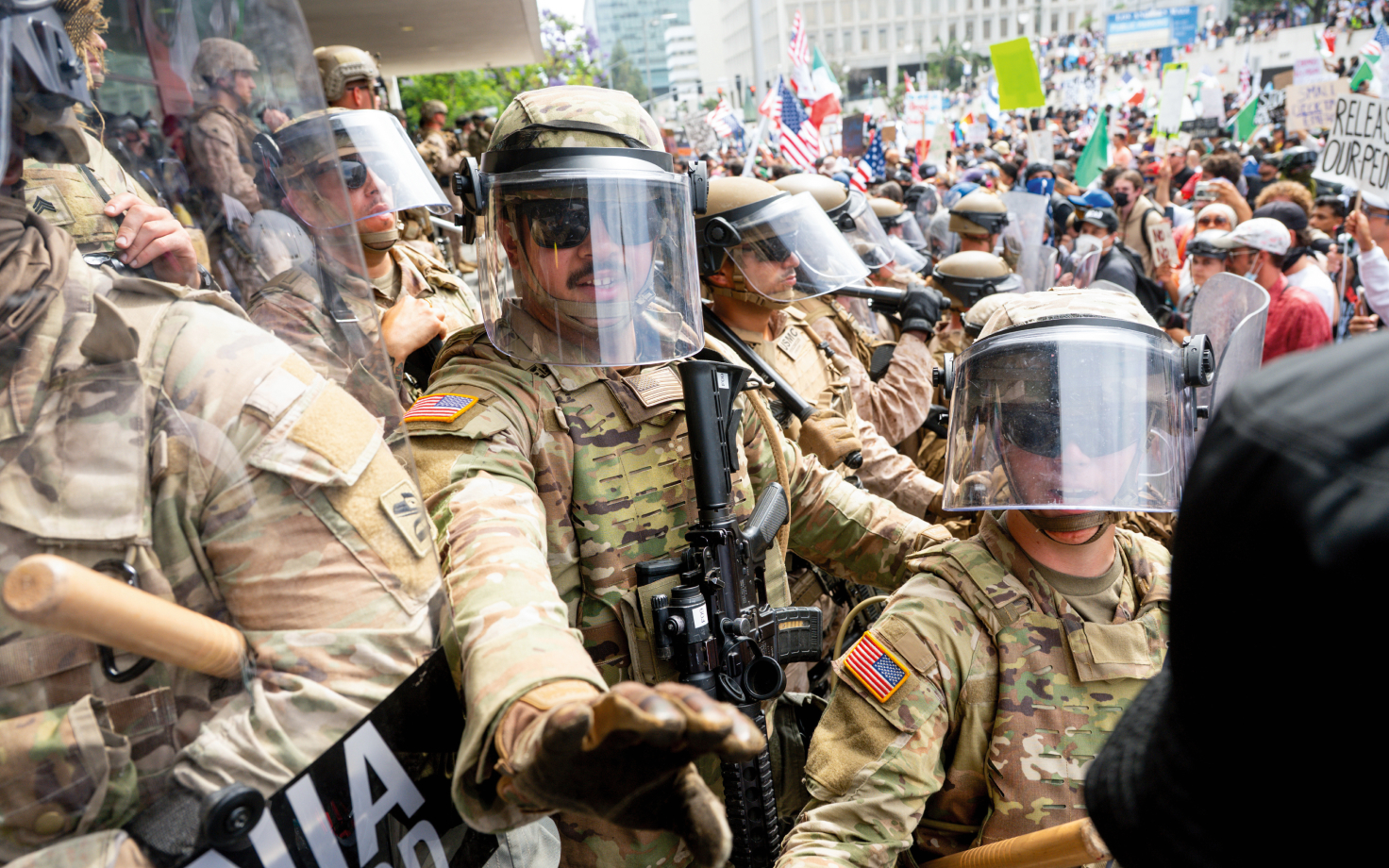
It was the Marines that especially caught the nation’s attention, at least at first. After all, there is no greater image of authoritarianism than armed combat troops in the street, wearing their camouflage fatigues, trained to fight the nation’s foreign enemies yet deployed instead on American soil (ordered there on the anniversary of D-Day, no less) and presumably prepared to face off against Americans.
Next in line would be the National Guard — less menacing than the Marines, perhaps, because they are literally our neighbors, who leave their homes, families and jobs to respond to natural disasters like the cataclysmic fires of a few months earlier. Yet they are also constituent parts of the Army or Air Force. On the president’s order, they are transferred from state to federal command. On duty, in their fatigues, they are indistinguishable to the average American from Marines.
And then there’s ICE and the Border Patrol, federal police whose authority is ostensibly limited to apprehending people who aren’t supposed to be here. If you’re a citizen, or a lawful permanent resident (“green card” holder), a refugee or an asylum applicant, until recently you weren’t likely to be troubled by or even to see the immigration cops, unless you were returning from a visit to Mexico or passing through the checkpoint north of Oceanside inside Camp Pendleton. Even undocumented but otherwise law-abiding residents who kept their heads down were generally left alone, although at perpetual risk of being exploited, reported, arrested, separated from their families and expelled.
A year and a half into the second Trump administration, we now know better. The presence of military troops was little more than an exercise in power, politics and performance. It was not the Marines who snatched people from car washes or Home Depot parking lots while they worked or sought work. It was not the National Guard that grabbed young students on their way to school, families on their way home from church, asylum applicants sitting in court. The military did not shoot a Los Angeles man dead on New Year’s Eve after the victim fired a celebratory shot in the air, as an off-duty ICE agent did.
Americans instinctively know the difference between military troops, who are deployed to our streets only during emergencies, and police, who are there in the normal course of everyday life and generally respond to local rather than federal or state authority. But the lines between these forces can blur. When police come in the form of large contingents of federal agents who dress and behave like soldiers, they can for all practical purposes occupy cities militarily just as surely as the Marines or the National Guard. The peril they pose to freedom and local control can be just as great. The ongoing deployment of agents, even more than the presence of Marines and National Guard, should spur some serious reexamination of presidential powers to deploy federal agents, and of the adequacy of safeguards that ought to protect states, cities and individual Americans from abuse.
Most of the 700 deployed Marines never even set foot in Los Angeles, except for a small contingent briefly stationed at the Federal Building in Westwood. The
rest clustered in tents miles away in Orange County, with no clear mission, before being rotated out and sent back to their base in Twentynine Palms.
On the street level, there wasn’t much evidence of federalized National Guard troops, either, except for a few protecting federal buildings downtown in the early days of the operation and, a month later, when they joined in the immigration cops for a bizarre march through mostly empty MacArthur Park. The spectacle was apparently an attempt to intimidate local residents, many of them immigrants from Latin American countries. Some agents were on horseback. They looked less like a heroic D-Day brigade or fearsome stormtroopers than a team of actors rehearsing a military comedy. Plumed helmets would have fit right in.
Los Angeles was Donald Trump’s opening gambit and was followed by chaotic assignments of federal agents to Portland, Chicago, Minneapolis-St. Paul and elsewhere, and a tragic deployment of National Guard troops in Washington, D.C.
For context, it’s helpful to recall how Trump responded to protests in 2020, during his first term, in the wake of the police murder of George Floyd in Minneapolis. Trump called the National Guard into the District of Columbia, where the president enjoys unique powers, and threatened to deploy not just the guard but regular U.S. troops in other cities. His top officials, including Attorney General William Barr, Defense Secretary Mike Esper and Joint Chiefs Chairman Mike Milley, objected to such a flagrant breach of norms — and, by the way, the Constitution. So did the governors of many U.S. states. Trump urged the governors to instead call in the guard on their own authority.
One did. That was Tim Walz of Minnesota, who formerly served in his state’s National Guard.
Dissuaded from sending in the military, Trump instead sent federal agents from a variety of departments into U.S. cities without local consent, ostensibly to protect monuments and buildings.
For Trump, a second term offers the chance at both a double-down and a do-over. After purging military leaders and selecting legal advisors and Cabinet members with less experience and more personal loyalty to him, Trump took control of the California National Guard from Gov. Gavin Newsom and ordered both the guard and the U.S. Marines into Los Angeles. It was just over five years since Floyd’s killing and the protests that followed.
The point was less the actual use of troops than the demonstration to the nation that Trump could — and this time, would — deploy them whenever he felt like it.
But military troops are of limited use to him. They are painstakingly trained and supervised, and subject to military codes of conduct and discipline. They have a heritage and a culture of loyalty not to any one leader but to the American people and the Constitution.
ICE and the Border Patrol, as currently constituted, have a much shorter history. They were re-created from predecessor agencies after 9/11 as part of the new Department of Homeland Security. The agencies grew rapidly with too little oversight. A panel headed by former Los Angeles Police Chief William Bratton found the Border Patrol’s discipline system “broken.”
A second expansion came last year after a supine Congress passed and Trump signed the “One Big Beautiful Bill.” Together with other agencies in the Department of Homeland Security, ICE and CBP agents form the nation’s largest police force.
Yet they dress not like police but like soldiers, and they scoff at decades of policing reforms and best practices, including such niceties as the Fourth Amendment and judicial warrants. Immigration enforcement is their justification, but the agents have stepped into the shoes of the military troops that Trump said he would use against “the enemy from within,” broadly defined as anyone who opposed him. They confront protesters, they arrest (“detain”) citizens, they lock up children.
The federal immigration agents, and not the Marines or the National Guard, form a key feature of anti-democratic, dictatorial rule: a paramilitary force, the identities of its agents hidden from public view, loyal to the regime in power.
Los Angeles was the opening act. But Minneapolis is where Trump tried to over-write the events of nearly six years ago: the police murder of George Floyd, and the Black Lives Matter protests that helped doom his reelection effort — and which for a brief moment focused Americans’ attention on continuing racial inequity, needlessly violent policing, and the danger that both pose to American justice and liberty.
Minneapolis is also where protester heroes took a cue from Los Angeles protesters and challenged federal agents, and did it undaunted by subzero weather. And it was there that events reached a crescendo: An ICE agent shot and killed Renee Good in her car, and CBP officers killed Alex Pretti in the street. Neither was a suspected illegal immigrant.
Court rulings have slowed federal incursions in some U.S. cities, and Americans are re-learning from news reports and commentary some basics about their laws and rights. What’s the difference between an administrative and a judicial warrant? When is the National Guard a state force, and when is it a federal one? What exactly is the definition of military troops, and when can the president send them into American cities? What powers do governors have to counter unconstitutional acts by the president when Congress refuses to act? What recourse do citizens have when their non-citizen neighbors are targeted?
These are among a host of fundamental questions for citizens of a free and democratic republic. The circumstances under which we try to answer them would have been unthinkable a few short years ago. Yet the questions are timely, as the nation fast approaches the 250th anniversary of its declaration of freedom from Britain.
It’s as good an occasion as any to debate who Americans are, how we protect our liberty, and whether a nation of freemen, as Lincoln said in his very first public address, must live through all time or die by suicide