
























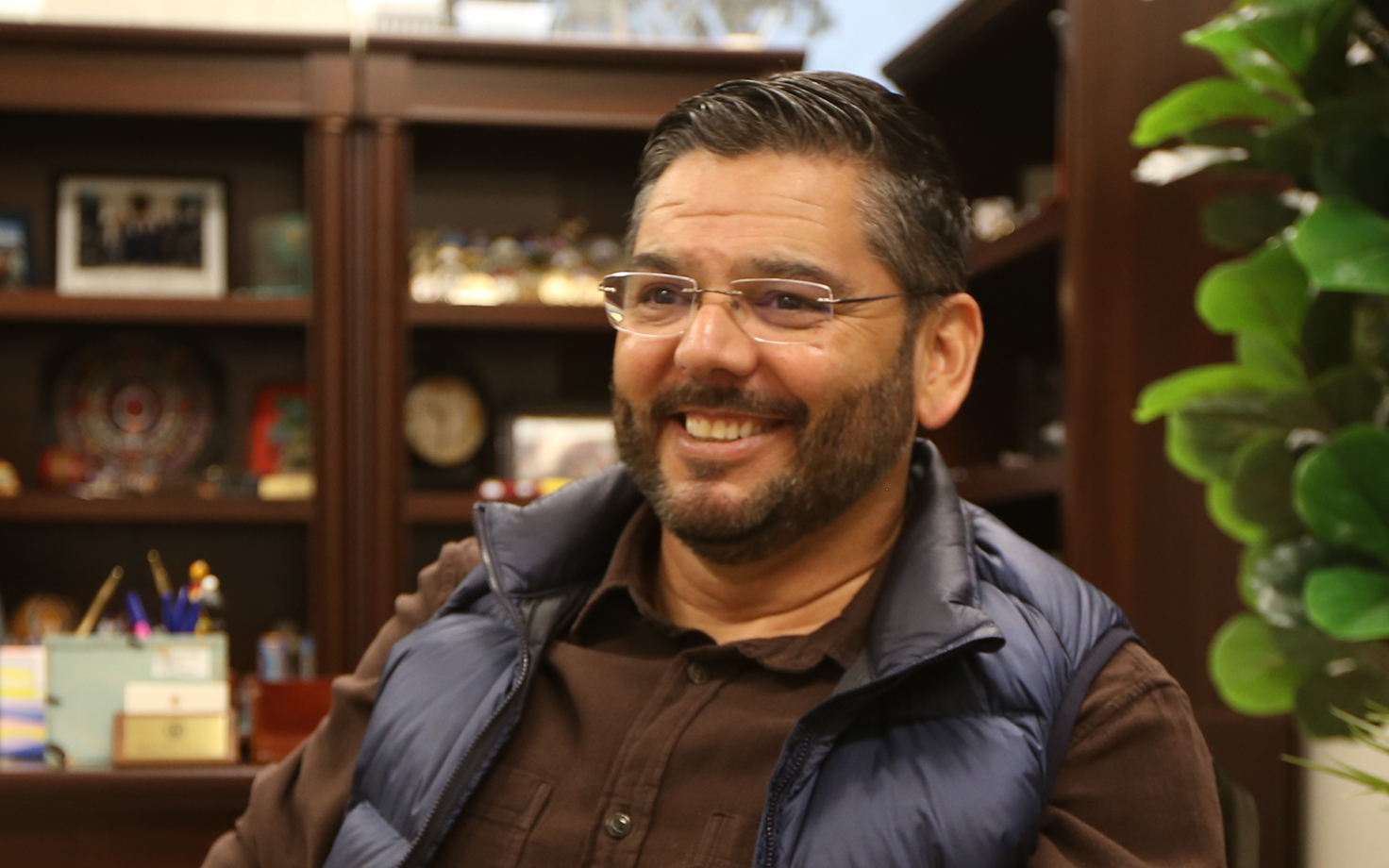
“I’m very angry right now,” Rep. Raul Ruiz posted on January 24 after watching the first videos of ICE agents fatally shooting Minnesota nurse Alex Pretti hours before.
“Not once did I see Alex behave violently or have a gun in his hands,” the California Democrat’s post said. “[Kristi] Noem [secretary of Homeland Security at the time of the shooting] needs to be impeached, and she along with all agents involved in this homicide need to be prosecuted to the fullest extent of the law.”
Weeks later, talking in his Palm Desert district office, Ruiz, a former emergency room physician whose district includes rich farmland, vacation resorts and large swaths of cactus and scrub in riverside and imperial counties, was still angry.
“We need to pass comprehensive immigration reform that will secure the borders, will stabilize our workforce and contribute to the economy,” he said in an interview, as well as create a more efficient and fairer pathway to citizenship for those who have been here.
But the Trump administration is uninterested in fixing the immigration system, Ruiz declared, his voice rising. “They’re fixated on the brutality and the violence of removing [immigrants], of dominating in this space.”
President Trump’s replacement of Kristi Noem with Markwayne Mullin won’t make any difference, Ruiz said. His appointment and confirmation is “not a policy change, it’s a change in communication strategy.”
The pathway to a fairer, more efficient system, he said, “has to start by removing Donald Trump and Stephen Miller,” among others.
Blunt talk, thoughtful colleague
Ruiz’s bluntness on immigration seems at odds with a lawmaker whom colleagues and constituents know as thoughtful and collegial, even informal — often in khakis and rolled-up shirtsleeves.
“Raul is an all-around good guy and has the heart for public service,” said Rep. Gus Bilirakis, a Florida Republican. He and Ruiz have partnered on several bills in recent years and meet for dinner in Washington.
Ruiz’s district, CA 25, was once more red than blue. However, his constituents have reelected him six times since he took office in 2012 by defeating long-serving Republican Mary Bono Mack. In 2024, he won reelection by 13%.
The son of Coachella farmworkers, Ruiz’s humble beginnings in Coachella Valley and Horatio Alger story have earned him votes from Latino constituents, including many who voted for Trump in 2024. At the same time, his reputation as a longtime community doctor and his focus on healthcare issues in Congress won local white retirees, said Mike Madrid, a political strategist and observer of California politics.
Born in Zacatecas City, Mexico, the 53-year-old lawmaker came to the United States as a baby. After the death of his biological mother, he was adopted by an aunt and American-born uncle who brought him to the U.S. and raised him in Coachella. He and his mom became citizens in the 1980s.
“They are my mom and dad in every aspect of the word, my heart, my soul and my love.”
The family lived in a trailer until his father was promoted out of the fields into a packing house job and could afford a larger home in the Coachella barrio. His mother still lives there.
He credits his family and his barrio neighbors for nurturing the service “heart” that Rep. Bilirakis admires.
“I know firsthand the hard work they put in to give their families and their children opportunities that they never had, like my parents did for me,” Ruiz said. “I know them,” he said. “They fear God. They worship in the same churches. Their children went to school with me.”
He is particularly incensed with the way Trump and Miller have branded immigrants as dangerous “others,” a characterization, he insists, that has already proven costly to all Americans.
“We know that immigrant labor contributes to the solvency of Medicare and Social Security,” Ruiz said. Without the taxes immigrants pay into those critical programs, he said, they will run out of money sooner.
Another example: The nearly $1 trillion in cuts to Medicaid, he said, that Congress passed last year as part of HR 1, the One Big Beautiful Bill, jeopardized the financial stability of hospitals that serve immigrants eligible for medical care — as well as all citizens.
Crackdown costs
Falling reimbursements will force hospital officials to shutter less profitable departments like pediatrics, labor and delivery, even emergency rooms —or close altogether, as is already happening in poor and rural communities. Hospitals that remain open, Ruiz predicts, will have to make up lost revenue by charging more, forcing private insurers to cover those higher costs and, in turn, pushing insurance premiums higher for everyone.
Andrea Silva, who teaches political science at UC Riverside, agrees. By demonizing immigrants, we underestimate their considerable contributions to the country, financial and otherwise.
“They may be net users [of resources] in the first generation, but by the second generation, they are net providers,” she said.
The administration’s often violent arrests and deportations don’t distinguish between strivers like Ruiz and child traffickers, Silva said.
They pick up people based on administrative, not judicial warrants, she said, and judge them in administrative courts — and have little or no accountability. “It’s unfair and unjust.”
Meanwhile, “We need agricultural workers,” she said, and H-2A visas. Such temporary visas for seasonal agricultural workers are expensive and difficult for employers to obtain. When farmers can’t get enough of those visas, she said, they often subcontract to a middleman who ends up finding undocumented people to cultivate and harvest crops.
“We need a better understanding of what migrant labor does for us,” Silva said.
“My mother is an angel,” Ruiz said. “Even though we lived in a trailer and were poor, she fed the hungry and gave clothes to people who needed them.”
When, as a child, he told her that he too wanted to help others when he grew up, she steered him toward medicine.
College was the first hurdle. The summer before his freshman year at UCLA, Ruiz wrote a “contract” in which he promised to return to Coachella as a physician if neighbors helped him fund his undergraduate studies at UCLA. The 17-year-old printed copies, borrowed a briefcase and put on a suit in the 120-degree summer heat. He went door-to-door among Coachella’s merchants, distributing his contract and raising $2,000, enough to pay for his books. He graduated magna cum laude.
Harvard Medical School followed, along with two master’s degrees — in public health and public policy.
Ruiz trained in emergency medicine at the University of Pittsburgh. (Yes, he watches “The Pitt,” HBO’s award-winning series set in a Pittsburgh ER. “I can’t turn it off,” he said, “and, yes, that is the life of an emergency physician.”)
After med school and while earning his master’s degrees, Ruiz treated patients in the Chiapas jungles and consulted with government officials in Serbia and El Salvador on medical care delivery in those countries.
Then, as promised, he moved back to Coachella. Ruiz helped create the nonprofit Volunteers in Medicine, which provides free or low-cost primary care for local residents, and a mentorship program for local pre-med students who want to serve their communities.
He met his wife, a former ER nurse, when the two worked at the Eisenhower Medical Center. The couple live in Indio with their twin school age daughters and Blue, the family’s large white Husky and Ruiz’s running partner. Their photos hang in his district office, a cozy space crowded with books, plants and an array of plaques and certificates.
Congress was never part of his plan, Ruiz said, with a laugh that accentuated his dimples. But when his predecessor, Rep. Bono Mack, supported a 2009 Republican policy statement calling for gradually converting Medicare from government insurance to government-subsidized and government-approved private insurance, he decided to run. He lost that race but unseated her two years later.
Last year, he and Rep. Bilirakis introduced legislation they hope will help prevent doctor shortages in Medicare by ensuring that payments better reflect the real cost of delivering care, especially in rural, underserved and low-income communities.
The two congressmen also helped draft and pass what ultimately became the 2022 PACT Act, providing benefits to veterans who develop any of several medical conditions following exposure to toxic substances while serving in conflicts abroad.
Their bipartisan partnership and friendship seem an exception in Washington DC.
Another example of polarization is Ruiz’s Humanitarian Standards for Individuals in ICE and CBP Custody Act. He introduced it in February. The measure would set medical and safety standards for a growing number of detention centers where immigrants are being held under Donald Trump.
Since these operations began, more than 55 people have died in the custody of ICE and Customs and Border Protection, Ruiz said angrily. Seven detainees have died already this year.
“We’ve heard reports of detainees not able to find space on the floor to sleep, freezing temperatures, inadequate food, lights on all the time,” he said. “We’ve heard stories of their inability to take showers or wash their hands freely.”
The measure should be an easy one for even Republicans to support, he said. His bill currently has 87 co-sponsors, but he doubts he’ll get a single Republican to sign on, even from among the 20 physicians now in Congress.
Will the measure be heard in committee?
“No.”
That bluntness again.
Ruiz is betting on the midterm elections, but he is realistic about the limits of even Democratic victories.
“When Democrats win back the House, there’s going to be opportunity to create more transparency and to hold [Trump] accountable through the power of the purse and legislation,” he said. “The president may veto, but it would be a strong rebuke.”