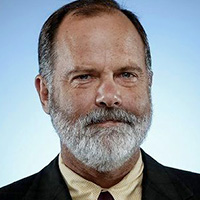




















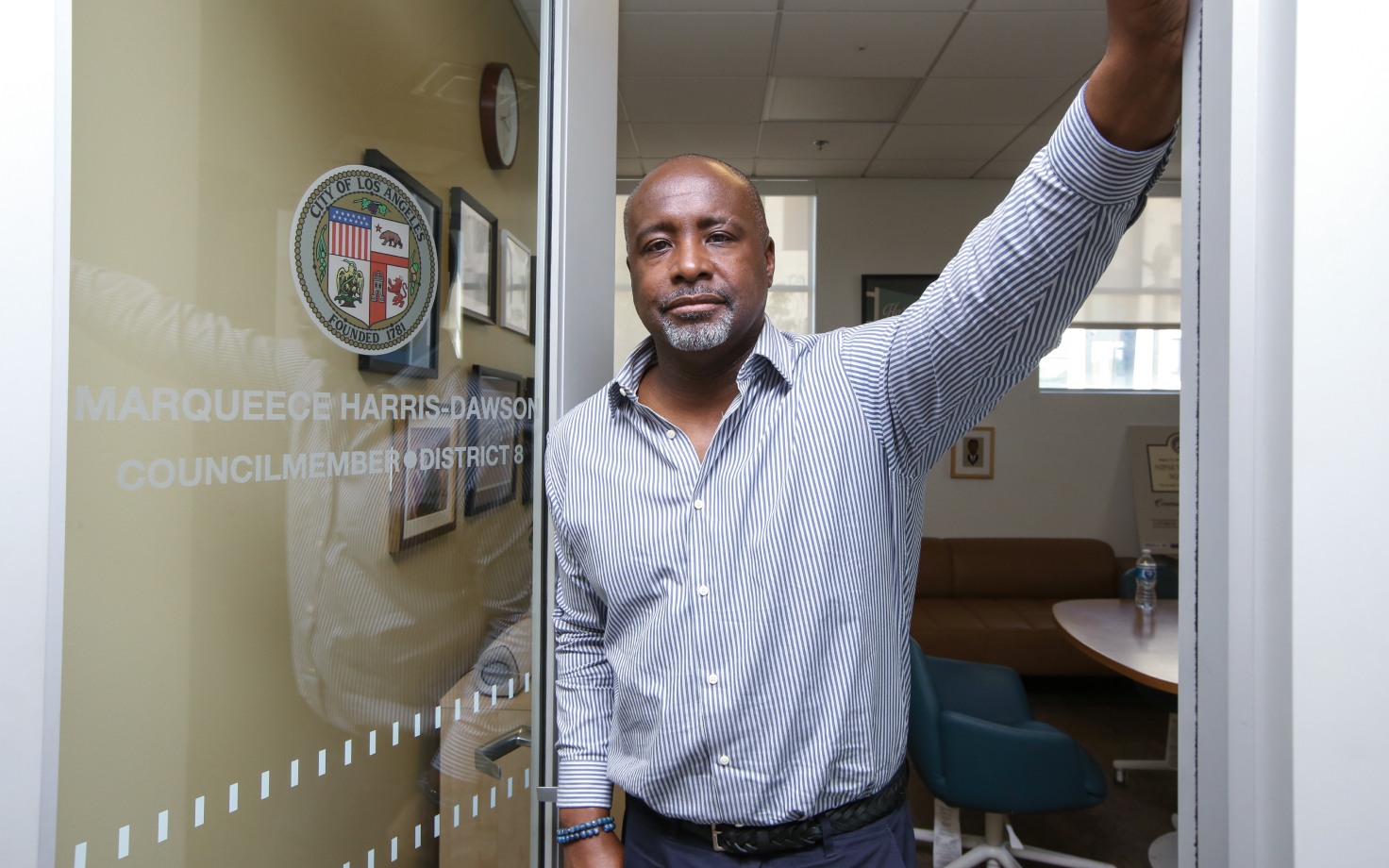
In the fall of 2015, Blueprint was a new magazine, publishing its second issue, and Marqueece Harris-Dawson was a new face in Los Angeles politics. We described him then as “a politician with a different style, different allies and even different looks” from his predecessor on the Los Angeles City Council, Bernard C. Parks. That description holds up nicely.
It’s 10 years later, and we’ve grown up together, Blueprint finding its place in the civic information infrastructure, and Harris-Dawson rising to the office of City Council President. Harris-Dawson’s ascent has been no accident. He combines refreshing candor with a soft touch, and he has bridged the seismic shift that is underway in this city’s politics, as it moves from a moderately Democratic bastion to the home of an emergent left. Harris-Dawson once seemed at the edge of that change; now he feels more astride it, bringing deep experience and a worldliness to his work, earning the respect of traditional Democrats and the ascendant Democratic Socialists who now command a block of votes on the council.
It was thus with some nostalgia and a palpable sense of time passing that editor-in-chief Jim Newton and the council president sat down this spring to reflect on the city and its challenges. An edited version of their conversation follows:
BLUEPRINT: I thought, since we go back to the beginning of this magazine, that we could start by looking back over these past 10 or 11 years. What has gotten better about L.A. over that time, and what’s still eating at you?
COUNCIL PRESIDENT MARQUEECE HARRRIS-DAWSON: At the meta level, … I would say that Los Angeles, at the time we were talking then, was in the process of closing an old political chapter, a political order, and opening a new one, which is exciting but also scary as all get-out. At least you knew how the other one worked, what was possible and what wasn’t possible.
This one is very different. We don’t live in an environment where incumbents are safe. We don’t live in an environment where there are third rails that you can’t touch….
We have two people on the council that people spent millions of dollars saying they were basically complicit in high crimes because they opposed greater police funding. In the old political order, you were done [if that happened]. You didn’t even want to get close to that kind of accusation.
I can remember when some of the activists who were a bit older than me, to be sure — Antonio Villaraigosa and Karen Bass and even Mark Ridley-Thomas and Gil Cedillo — ran for office, there was this big fear that whatever run-ins they had with law enforcement when they were young activists would become a central issue. Now, that’s just nothing.
BP: That would be a source of pride now?
MHD: Yeah, or just not a thing. And there are a variety of issues that are like that. Land use is another one. If you came out for density or upzoning, that was dead on arrival. The debate on that has completely changed.
It doesn’t mean that there isn’t a debate on that, but you can actually have a debate where both sides are represented.
BP: One side is not prohibited from speaking up…
MHD: Exactly.
So I think we’re entering a new political order. It’s turning out that I’m more of a bridge than a member of either [order]. You remember that when I came in, I was quite critical of the older guard, but I didn’t have in mind that it was going away. I didn’t have that idea.
It’s been a very fascinating time to be in local government.
BP: Do you feel that you’ve changed during this period? You’ve talked about the atmosphere around you, but how about you? You’ve learned a lot, I’m sure, but do you feel philosophically changed?
MHD: I wouldn’t say that I’m changed at the level of philosophical difference. Something I remember saying when we spoke 11 years ago — and I remember it because it was the first time I’d said it out loud — I felt like I had a lot of preparation to be in public office, but I didn’t have the emotional preparation. And so in that way, I feel like I’ve changed. I don’t run as hot or cold.
You learn that in a city this big, when you wake up, it could be anything. You could be under federal occupation. Half your city could be on fire. There could be a giant sinkhole. It’s just the nature of running a big city. Stuff happens.
And it’s different from being an activist or a commenter or even a member of the council, where your instinct is to look for someone to blame. When you’re running a city, you don’t have time for that. You really have to fix the problem.
The political conversation is often about whom to blame. But when you have responsibility, the requirement is to deal with the issue in front of you.
BP: And how good is the city at solving problems?
MHD: The city is good at solving problems, the vast majority of which the public doesn’t ever know about. That’s the thing with the government. When it’s going great, it means you never hear about it. If you hear about it, it’s because there’s a problem of some sort that’s not being resolved.
I have come to have profound and deep respect for city workers — all the engineers and accountants and investment managers who figure stuff out; lawyers who figure stuff out; workers who just solve a problem so that it never bubbles up. I can’t tell you how often I go to a neighborhood council meeting or run into somebody in the supermarket and have somebody say, “Hey, we had a problem with this intersection and so-and-so called out some engineer, and it was all fixed.” And I had never heard a word about it. And so, to that extent, the city works great.
I also watched city workers take us through COVID. COVID obviously was a disaster and a tragedy, but when I saw what the city workers pulled off during that time, it was very, very impressive. And they did it without us having a big loss of life. We lost some people for sure, but compared to the other big cities, we did really, really well. [Editor’s Note: New York City, with a population of 8.3 million people, suffered about 45,000 deaths from COVID; Los Angeles County, with a significantly larger population of about 10 million, had notably fewer deaths, roughly 36,000].
BP: I find it frustrating now to see this revisionism setting in, with some people arguing that COVID was no big deal because more people didn’t die, rather than acknowledging that the steps that places like Los Angeles took to protect against the epidemic are precisely the reason that more people didn’t die…
MHD: Exactly. One of the things that’s frustrating about government is that people forget about comparative science. Look at cities our size and compare them. If you want to say that Mexico City, for example, is about our size and they did better, then that’s an argument we can have, but it’s hard to argue that it wasn’t a big deal, because in some places it was a very big deal.
That’s where I think the government does a great job, and we don’t often know about it.
BP: How has the council changed in the time you’ve been a part of it?
MHD: The council is vastly different. When I first got to the council, the only two members who did not have any experience in the city public sector were me and David Ryu….
It was a very insider game. Now we have a council where a majority of the people, this is their first foray into city government, so it’s a different thing. And obviously, we are majority women now — when I arrived, there was one woman out of 15 members, Nury Martinez. I don’t know what the average age was then or what it is now, but it’s vastly younger. I was one of the youngest people there then; I’m one of the oldest now.
It’s a young council, and we have a handful of council members who are renters.
BP: I believe it’s true that when Alex Padilla [now California’s senior senator, then a 26-year-old newcomer to elected office] was elected in 1999, he was still living at home, and I believe he was the only member of the council who did not own his own house. That’s a big change.
MHD: When you’re a homeowner, you have a different relationship to the city than when you’re a renter. You just do. Different interests. Different things are important to you. That is a very real, material difference.
Age is a material difference, too. We have way more parents of school-age children now. … We have far more people who are single than before. It’s people living different lives.
BP: Does the council feel more representative of the city now or less?
MHD: Definitely more representative of the city. Part of what happens when you have a structured order is that society moves, while the structure doesn’t. The structured order gets more entrenched. … To have a council with no renters on it when, even then, you had a city with easily, easily 35% or 40% renters, just that, by itself, says something.
We’ve also broken out of a little bit of the machine politics, where you have to be from a certain group to get elected, or you have to pass through a certain process to get elected. You now have a lot of people on the council who didn’t pass through any of that. And they’re there, and they’re just as strong as anybody else.
BP: It feels like we’re at a moment where we’re developing new political coalitions, but still looking for governing coalitions…
MHD: It will form because of the people who’ve won and made inroads. There’s nothing worse than being an insurgent and then having no backup. It means you can’t do anything….
The other thing that will happen is that there actually is a governing coalition. Members of that coalition don’t want to accept that they’re part of it because they still think of themselves as outsiders. They still think of themselves as the insurgency, but I keep having to say: “No, no, no, you have the votes. That’s the deal.”
BP: That’s a hard psychological switch to make.
MHD: It’s a very hard flip to make.
BP: There are still conservatives in this city. There are even some Republicans. Do they have a right not to feel represented by their council, their mayor?
MHD: I think they’re represented, overrepresented. They are overrepresented on the council. Let’s just take the ratio of landlords to tenants in this city. To listen to the council debate, you would think that there’s an almost even number of each. In fact, one number dwarfs the other.
I think that the nature of politics and the role of money in politics insures that those interests are represented and will continue to be represented for the foreseeable future. Now, what they do with their representation is another matter. The whole idea that you could dominate politics — I don’t think that’s in the cards anymore, as it’s historically been.
BP: Are there policies or priorities of the city that you can point to that reflect that changing balance, the evaporation of that dominance?
MHD: Yeah. There are robust conversations about police funding, for example, that would have never happened before. And it’s not an automatic, one- side-against-the-other [debate]. People go back and forth depending on the situation. That, to me, is the most glaring example of [the new balance on the council].
But there are others. The Rent Stabilization Ordinance hadn’t been updated in 48 years. We did the Tenant Harassment [Ordinance]. We did no-fault eviction. Those are things that just didn’t see the light of day in prior councils. Those are examples of issues that move that couldn’t move at all before.
We hadn’t raised the sanitation fee. We were 10 years late on that because we had some members who said, “We’re not voting for new fees.” But what happens is, you still have to pick up the trash, and you still have to pay for it. And you have lighting assessments. There are a number of things.
I don’t have to tell you what the prior council would have done. They just didn’t do it. It came up. We were at a deficit, and they just didn’t do it. They said, “We’ll do another study.” Or, “We’ll wait for manna to fall from heaven.”
Now you’re seeing people step up and take responsibility.
BP: What about the other side of that? Do you feel like the city’s finances are well-protected at this point?
MHD: I think they’re well-protected. The city could use a lot more room for comfort. But the city’s budget is designed to never collect a penny more than it takes to actually run the city.
I haven’t seen a big downturn like we saw in 2009, but I was here for COVID, when we went over what the layoffs were going to be until Biden came in and rescued all the cities. So I saw what was going to happen, and it was parallel to what had happened in 2009.
But I’ve been at the City Council when the economy was humming, and we had a surplus … the biggest reserve we’ve ever had. We were hiring back the positions we’d eliminated in 2009 less than 10 years later, and we were not facing bankruptcy. It was all fine. And one of my staff stopped me from getting on the mic and saying: “But it still takes two years to get your tree trimmed.”
So even when the economy is performing at its best, the way that taxation and revenue is set up, the city still doesn’t have enough to run it at the level that it’s supposed to run. So that’s the challenge financially. You can succumb to feeling like we’re always on the cliff. What you learn over time is that’s by design.
BP: The cliff is where you live.
MHD: (Laughing) The cliff is our address. … Even when you have a surplus, you can’t hire a bunch of workers because then you have them for another 30 years…
There’s a sense in which you’re always running behind. Sometimes you’re running far behind, and sometimes you’re running close behind. And that’s just the challenge of the way cities are financed in our country.
BP: Is the city where you would like it to be in preparation for the Olympics?
MHD: Mostly. I would say most of the big items are in place. And, frankly, it is the outstanding parts that are most public. So this debate between the federal government, LA28 and us over who’s going to foot the bill and what are going to be the arrangements, that gets a lot of public press. But all the other things that have been worked out — around water and utilities, transportation — that doesn’t get any ink because it’s getting figured out.
Security is a real issue. I am very concerned about it, and a host of people are very concerned about it. This is where you have to be comparative. One of my good friends compared it to getting ready for a prom, and said proms are better planned [civil rights lawyer Connie Rice, in an interview with LAist, criticized the city’s efforts, saying: “I know 10th graders who plan their prom better than this.”]
Well, OK, other places have had the Olympics. We can compare where they were at this point to where we are at this point. And a big difference with L.A. … is that we don’t have to build anything.
We sent a delegation from my team to Italy for the Winter Olympics. When they landed in Italy, the stadium for hockey was not finished. They got there the week the Olympics started, and the stadium was not finished because the hockey games did not start until the middle of the second week. Not that you want to use that as an example, but there are things to compare to…
I’ll tell you what I’m worried about on the Olympics. I’m worried about the international situation. FIFA [the World Cup] has already gotten complicated. And I don’t know what the ultimate resolution will be, but Iran qualified for two of the games that are supposed to be here, and they’re not likely to come. Even if they were willing to come — if the Trump government lets them in — if we continue on the path we’re on, I can see a scenario where a number of countries boycott. The IOC [International Olympic Committee] has made it more difficult to boycott … but at a certain point, the IOC is only as strong as the countries that are in it.
BP: You have the strong possibility that you’ll have a governor, a mayor and a president who will not see eye to eye on these Games. I don’t know how important that is, the Games don’t exist to make the president happy, but it does seem awkward.
MHD: It is awkward. It is every bit as awkward as it seems, if not more. … But I don’t think any configuration of people involved could offset the drama and chaos that Trump causes. It wouldn’t matter who it was.
BP: On the subject of Trump, ICE. How do you assess the city’s response to these ICE raids, going back to last summer and continuing through now and likely into the future?
MHD: I think the people of this city have responded in a way that I’m so incredibly proud of. No matter what part of town you’re in, ICE shows up and people hit the streets. Whether it’s Eagle Rock or Van Nuys or Woodland Hills, South Central, San Pedro, people hit the streets, they start taking pictures, they start doing what they can.
Mostly what the people of Los Angeles have done is that they will not let ICE conduct its business in peace. Which is important. It’s going to be known: The people don’t want what you’re doing.
I’m just been so proud of this city, from one end of the city to the other.
Our elected officials have been great. The council has been great. The council has been unified on it. There hasn’t been any daylight between any factions of the council on the issue. We’ve resolutely rejected ICE, and said we don’t want them here, and we’ll do anything we can to keep them out. That’s true of the council and of our citywide electeds as well.
The LAPD is in a tough spot, but also they have in many ways the highest profile. … I’ve been disappointed in the way the chief has talked about it. It’s a tight rope to walk, I get it, but this is L.A. and we’ve gotta do better. I wish that they could message better but also figure out a better posture on the streets.
BP: What would that look like?
MHD: I don’t know. I’m not law enforcement. But what they do, it looks like they’re giving security to ICE. You can’t even let it look like that. There’s got to be another way.
BP: I have to tell you, I’m not sure what a police sergeant or supervisor should do if an anti-ICE protester throws a rock at ICE. Who gets protected from whom? If the mission is to “protect and serve,” who’s entitled to that protection and service?
MHD: I don’t know what the right answer is. It’s a new situation. I understand that no one’s dealt with this situation before….
The other thing is that you want to make bold pronouncements. You might say: “Normally, we want to work with the feds on this issue, but while these ICE officers are in the streets, we can’t really work with them.” Our citizens don’t know who’s who or what’s what….
BP: I think about all the years and all the good consciousness-raising that happened around officers wearing their badges and identifying themselves. And then, all of a sudden, here comes ICE wearing masks and fatigues, and it really looks like kidnapping. It’s such a reminder that ground is hard won and easily lost.
MHD: That’s exactly right.