















In the months leading up to the midterm elections, concerns about democracy in the United States have gone from hot to boiling.
In a July prime-time address, President Donald Trump reiterated debunked claims about his 2020 election defeat and sought to paint a portrait of a voting landscape beset by fraud and lax security. The argument was roundly refuted by experts, and was largely ignored even by Republicans, many of whom seemed embarrassed by Trump’s preoccupation with past elections.
Democrats have spent the period sounding alarms and kicking against the salvos coming from the White House. At the NALEO conference for Latino/a elected and appointed leaders, held in Los Angeles a couple days before the president’s speech, Gov. Gavin Newsom, a frequent Trump foil, boiled down the opposition message.
“It’s a five-alarm fire, what’s happening to our democracy,” Newsom said. “It’s not the rule of law anymore. It’s the rule of Don.”
The takes of Gov. Newsom and President Trump reflect vastly different (and partisan) views on the state of American democracy. But while many people are focused on the stakes in this election, Newsom’s statement also reflects something academics on opposite ends of the country, and legal experts throughout the United States, are watching closely — the rule of law, and how Trump has undermined it since returning to the White House.
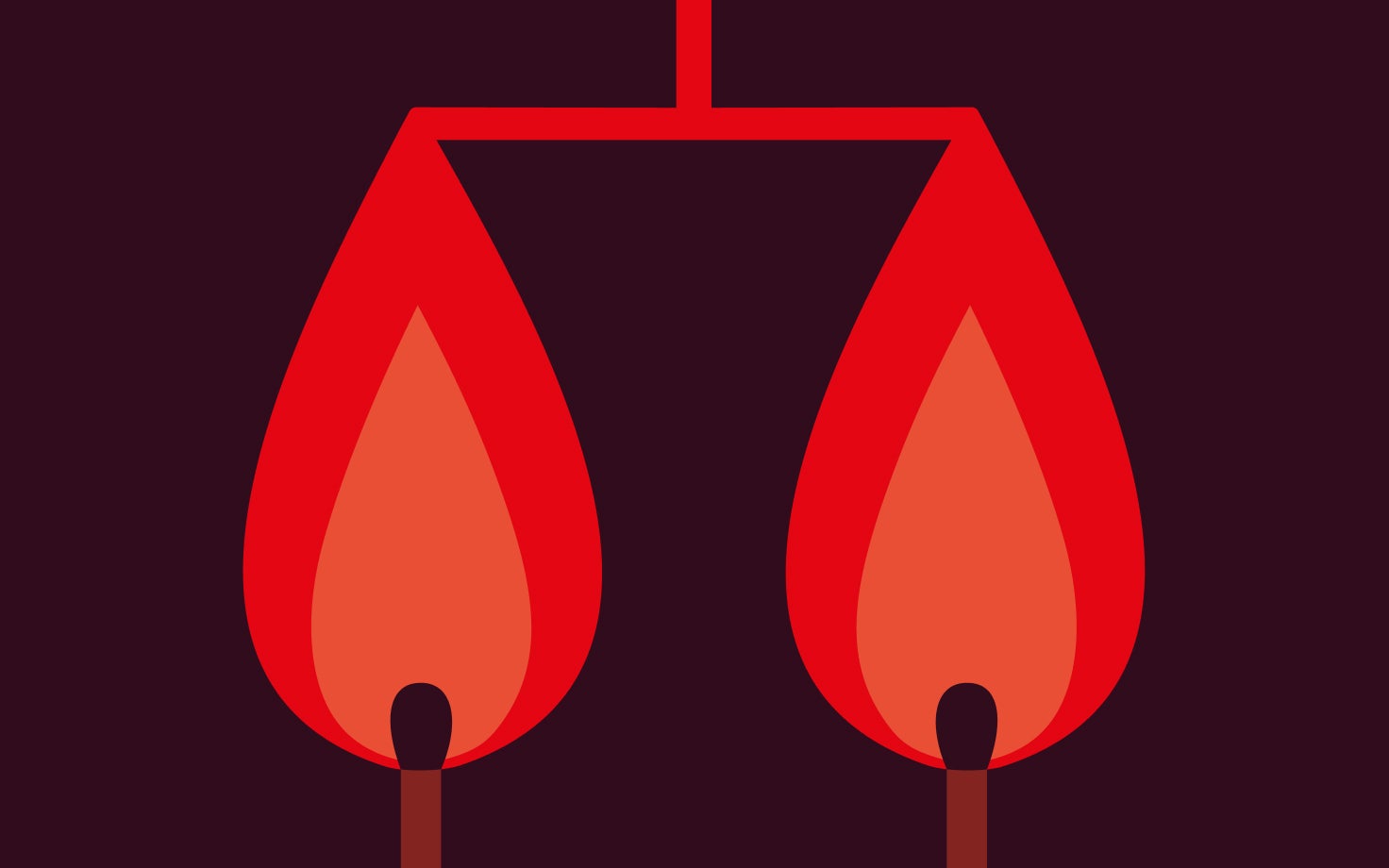
In May, the Safeguarding Democracy Project at the UCLA School of Law joined with Bright Line Watch to release a sobering survey of hundreds of top legal minds. The key takeaway: These scholars “perceive a significant erosion of the rule of law since Trump returned to office, including politicized law enforcement, a dysfunctional separation of powers, and executive-branch overreach.”
Those surveyed believe that adherence to the rule of law is at the lowest point in more than a decade, and the vast majority feel Trump’s second term presents more of a threat to that principle than his first term did. The experts cited serious concerns about the operations of elements of American government, including investigations conducted by the FBI and decisions from the Supreme Court.
What is “rule of law”? According to Professor Richard Hasen, who founded the Safeguarding Democracy Project in 2022, it’s the idea that no matter a person’s background, ideology or position in society, that person should be treated fairly under a known set of laws, with rules that are applied consistently.
Hasen observed that the legal experts see a greater threat than did a sample of the general public who were also surveyed.
“Lawyers understand ideas like the rule of law better than the average person,” said Hasen, who is also the Gary T. Schwartz Distinguished Professor of Law. “So what we see is that lawyers and law professors and judges who were surveyed are much more concerned about these things than the general public, and that should serve as a wake-up call that our democracy is in some trouble.”
Legal experts consider the rule of law
The report builds on work that has been ongoing for nearly a decade. Brendan Nyhan, a professor of government at Dartmouth College, has been involved with Bright Line Watch since its 2017 founding (he is one of four co-directors). The group has conducted 28 surveys, and historically, Nyhan said, it has gathered input from political scientists and others to address perceived threats to democracy.
With a broader aim to examine rule of law, Nyhan reached out to Hasen, who helped design both the survey and the population of experts who would participate (Dartmouth students were enlisted to help). This resulted in a pool of 23 federal judges, 113 “elite” lawyers, 193 law professors from top institutions, and hundreds of political scientists. There were legal conservatives (those who believe the Supreme Court should base rulings on an understanding of what the Constitution meant as originally written) and legal liberals (who think rulings should reflect a “living Constitution” whose meaning evolves over time, giving fresh perspectives to ideas such as “due process” or “equal protection”). Responses were gathered by email from Feb. 19 through March 6, and a survey firm was enlisted, so that researchers never knew how individual experts responded.
The findings yield a seemingly unending list of concerns in the wake of bold-faced actions undertaken by the second Trump administration, from the president’s pardoning of Jan. 6 defendants, to the issuing of executive orders targeting law firms that had represented his political opponents, to the investigations of former FBI Director James Comey and New York Attorney General Letitia James, and, of course, to attempts to assert federal control of elections.
The survey is broken down into sections, with sometimes alarming find ings. Under the “State of the Judiciary,” for instance, the report concludes: “Most legal experts agree that Trump is using executive power excessively.” Additionally, it found that just 20% of respondents “agree that the Supreme Court has made appropriate use of the emergency docket since Trump returned to office.”
The “Politicization of Justice” includes equally dramatic findings: The survey states that eight in 10 legal experts report that federal officials regularly fail to comply with court orders, and nearly 90% say Trump political appointees “mislead federal judges somewhat or very often.”
Nyhan drew attention to the finding that more than nine in 10 legal experts believe that the Trump administration has used the Department of Justice to go after political enemies or to benefit allies. He noted that this is consistent among both legal conservatives and legal liberals, a startling point of agreement that reflects the administration’s abandonment of standards that have governed the Justice Department for more than half a century.
“In the post-Watergate period we had very strong norms against the politicization of the Department of Justice and the FBI,” Nyhan said. “They were supposed to be intensely nonpartisan, and insulated from partisan influence, especially over individual cases, which is precisely the kind of influence Trump is seeking.”
The stark findings continue: About half of federal judges fear harassment if they rule against the federal government; 18% of lawyers said their firms’ decisions on whom to represent were affected “somewhat or very often by fear of adverse action by the federal government.” During Biden’s presidency, just 2% of those interviewed believed their firms acted out of fear of government retaliation.
The concerns extend to the Supreme Court, where three justices were appointed by Trump in his first term. Fewer than half of respondents report being “very or somewhat confident the Court will issue impartial decisions in cases involving the Trump administration.”
Here there was a significant divide: 82% of legal conservatives believe the court is impartial, while the figure is 19% for legal liberals.
The opposition
It is, of course, not hard to find warnings against presidential moves and perceived overreach. “No Kings” rallies have drawn huge crowds across the country. Hasen and other academics, such as Harvard professor and “How Democracies Die” co-author Steven Levitsky, are common sources for journalists.
Prominent political figures also regularly speak up. The morning before Trump’s speech, California Sen. Alex Padilla convened a roundtable discussion commemorating the legacy of late U.S. Rep. John Lewis, at which a bevy of officials blistered the machinations in Washington, D.C. “We’re not fooled by what this extreme Supreme Court is doing. They’ve been after voting rights for a long time,” said Georgia Sen. Raphael Warnock. Washington Sen. Maria Cantwell added, “Our constitutional rights for civil liberties and for voting are under threat by the president of the United States. Who would have thought that at our 250th birthday?
The Safeguarding Democracy Project stands out in part because Hasen launched it two years into the Biden presidency, when many (prematurely) assumed Trump was out of the picture. But Hasen said that, at the time, there had already been a “mushrooming of election litigation.”
The Safeguarding Democracy Project’s primary focus, expressed through research, advocacy, legal briefs and more, is to protect the right of eligible individuals to cast a ballot freely and fairly, with the results accurately tabulated and a peaceful transition of power. It’s work that prompted Hasen’s call for a constitutional amendment guaranteeing this right, defined in his 2024 book “A Real Right to Vote.”
With the midterms at hand, Hasen believes that the biggest threat is not, as some worry, National Guard or other troops being dispatched to polling places.
“If there are risks, they’re much more likely to happen either through trying to change the rules … as to who’s allowed to vote, like rules related to mail-in ballots, or after the election, to focus on tabulation or certification,” he said.
The situation is compounded, as he and others noted, by Trump’s dogged efforts to undermine confidence in elections, even if there is no credible evidence of fraud that could change outcomes.
That may be why, no matter what the results are in November, the legal experts in the survey do not anticipate any quick change. When asked to look into the future, the respondents predicted that the rule of law rating in 2032 would be above today’s nadir but still well below the level in 2015 — before Trump took office.
The report authors also expect that neither the 2026 nor 2028 elections will settle things. Nyhan said, “It will be really important to continue to defend and uphold the rule of law long after [Trump is] gone, because the threat is unlikely to disappear.”
Hasen concurs, saying that some underlying weaknesses pose challenges.
“We have a hyper-decentralized [voting] system, and weak constitutional protections for the right to vote, and so it leaves lots of opportunities for contestation and for malicious actors to try to take advantage of that,” he said. “So I’m afraid what I’ve termed the ‘voting wars’ are likely to continue for the foreseeable future, even after Donald Trump has left the scene, unless we make some fundamental changes to how we conduct our rules for our democracy.”